


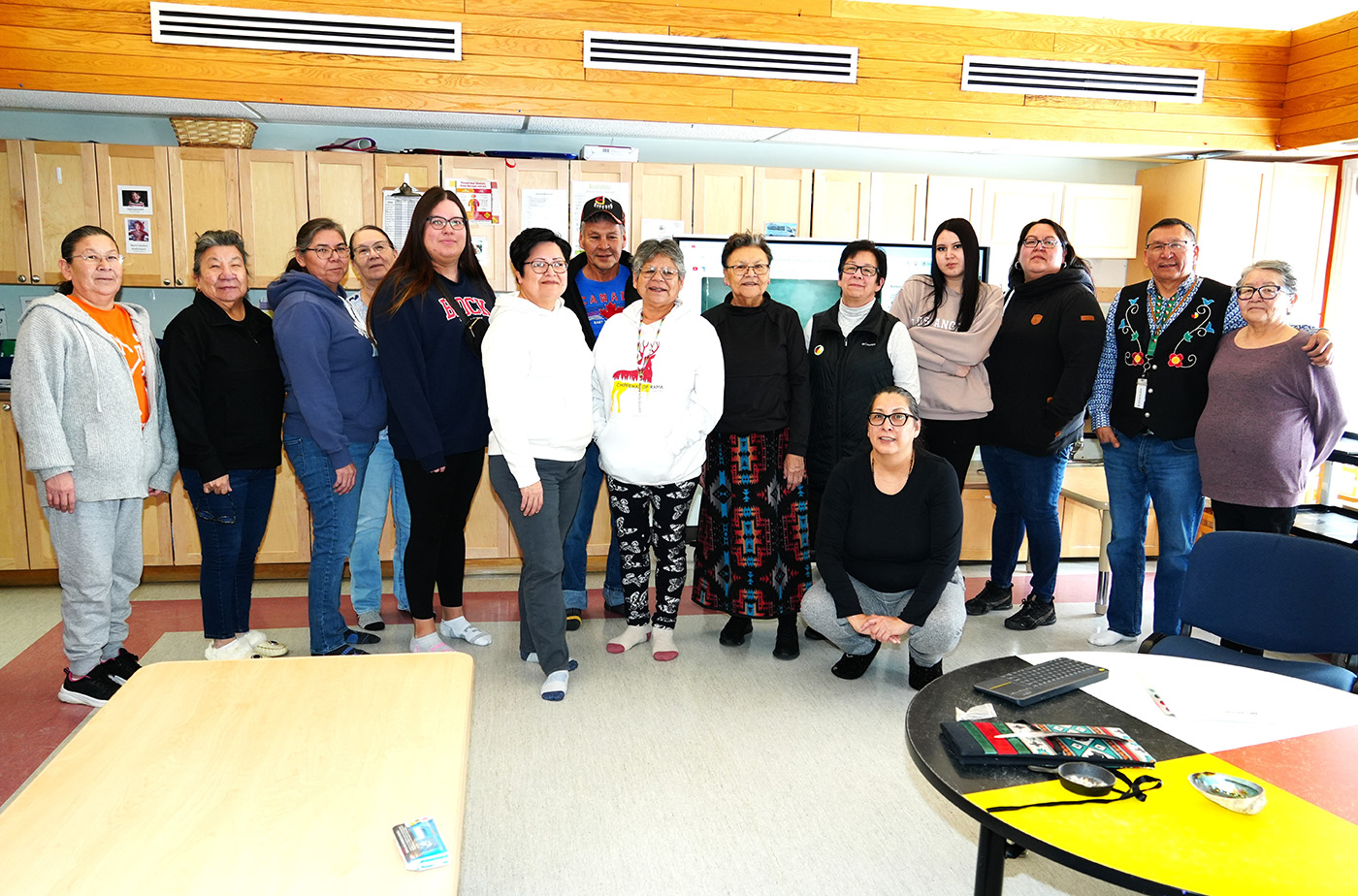
Shki Waase-Aaban Binoojiinh Gamik welcomed Barbara Nolan, Anishinabek Nation Anishinaabemowin Commissioner, and Lynne Pine, Barbara’s apprentice, on January 30, to the Daycare’s Professional Development Day. Daycare Manager, Rachel Toulouse, and Marjorie Southwind, Anishinaabemowin Manager, invited Barbara and Lynne to coach Education staff on how to incorporate Anishinaabemowin into the Daycare's daily operations.
Anishinaabemowin Programming in Early Childhood Learning Spaces and ‘recognizing the importance of language revitalization in early learning spaces for children and families’ was the topic of the day. Both Barbara and Lynne currently work at the Garden River Childcare Centre providing Anishinaabemowin language support and immersion programming. It is their passion; Barbara has many years of language proficiency and in providing mentorship, and Lynne is emerging as a Speaker and teacher with Barbara’s assistance and encouragement.
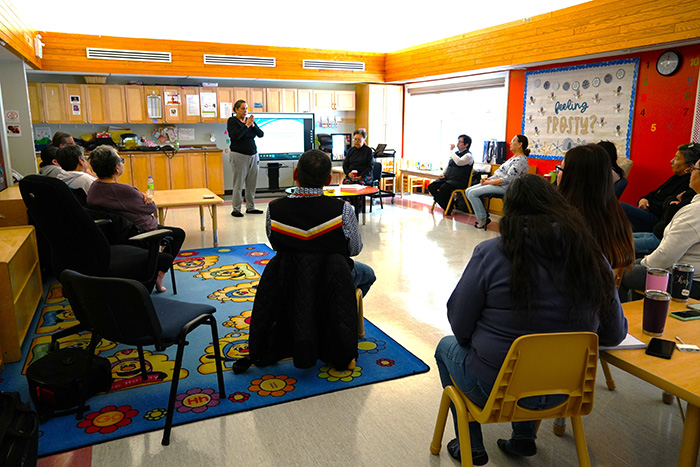
Opening prayer and smudge were offered by Michael Abitong, Land-based Resource Teacher, to start the development day off in a good way. Daycare Staff, Biidaaban Language Speakers, Land-Based, Educational Assistants, and Student Support Workers gathered for the presentation, which included the following themes:
- Strategies for incorporating Anishinaabemowin into our Daycare and continue supporting Biidaaban’s curriculum to revitalize the language.
- Ways to support staff who aren’t currently Speakers by sharing how to get started learning Anishinaabemowin, offering resources, teaching tools, and Speakers on hand.
- Encourage staff to use the language daily with students and offer positive reinforcement when they do!
- Use the language daily, and whenever possible, to keep it alive; immerse students and fellow staff members in it.
- Repeating words, phrases, and introductions, and practicing these repeatedly will instill the language in learners, parents, and staff, making it familiar and comfortable over time for all who use it.
- Make learning the language fun for staff and students!
- Use the language in daily life to increase your knowledge and inspire new vocabulary when you don’t know the word;
- Speak/listen with Elders or others who know Anishinaabemowin – conversation and hearing the language spoken helps us learn and retain it.
Barbara poignantly summed up these points when she stated, “If you’ve got words, use them! If you don’t use them, our language will disappear. Our ways of being will disappear.” Even if you are not a Speaker, Barbara emphasized, just use the words you know or learn things like “sit down”, “be quiet”, “listen”, “sleep time”, “let’s go outside” – things you would commonly use with young children and students. To protect, maintain, and preserve our language speakers, it needs to be used in everyday life, Barbara reinforced. “We have to produce speakers!” she exclaimed. The necessity of speaking, hearing, learning, encouraging, and immersing ourselves in the language in our daycare and schools is paramount. “Let’s move forward!” Barbara spoke genuinely. “When they told us not to speak our language, we lost something inside too (I’m not good, I can’t be proud of being Anishinaabe) but we need to lose those thoughts, put it behind us and move forward. The time is right to reinvigorate our language.”
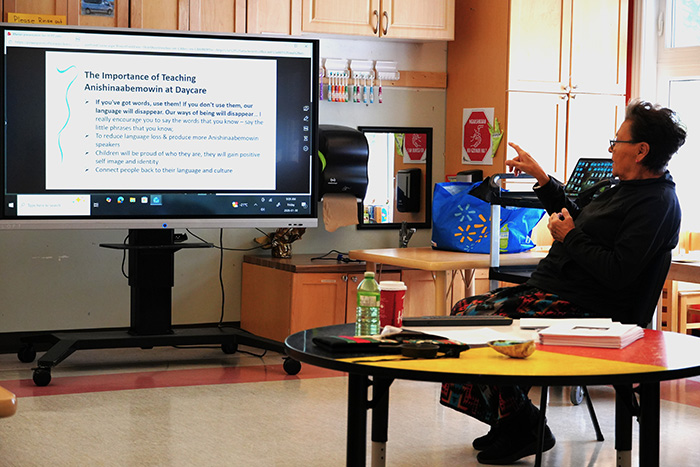
Barbara addressed the concern about how to teach if you are not a speaker yourself. Her response was powerful: We don’t start by teaching, we start by speaking. Barbara held her hand over her heart as she spoke endearingly:
“Use whatever words you know. There is no need to translate at the Daycare level. We want students to start picking up the sounds of the language, to hear us speak. Sagamok has a specific sound, a distinctive sound that is very beautiful. Little words at a time because that is all you need to start with. Put ‘life’ into your words when you are speaking to children. Anishinaabemowin is spoken from our heart and describes a story or event, so put some feeling into it when you speak. Actions that accompany the words will also reinforce the language with new learners. Just sit and listen to our language being spoken and let it flow over you. There’s a lot to learn, but you’ll get there! Utilize Steven Bennett as your Resource to learn how to speak/pronounce or what to say – build your vocabulary this way. Learn songs and read books in the language to the students. Incorporating the language and immersing the students in it daily will make a big difference. Many of you are just learning, and there is no need to feel afraid or overwhelmed – practice, practice, practice and be expressive.”
The presentation went on to talk about the basics of language acquisition. “How do we acquire our first language?” Barbara asked rhetorically. She then explained that the language we hear as an infant is our first language, also known as our acquired language. We don’t actively learn this language; we acquire it through hearing, speaking, and absorbing it through daily exposure. Barbara continued, “We can learn so much through listening, observing, and taking it into our language acquisition device – we all have one and have this ability – it’s how we learn.” She went on to say, “Your language and speech emerged through stages – first words, then phrases, then forming sentences/paragraphs of thoughts. Corrections were made through our parents' modelling the correct words or ways of speaking. Reading and writing are not at the preliminary stage of learning a language – that comes later. First comes hearing and listening.”
Our language acquisition device is like a cup, Barbara gestured. Fill it up to become a fluent speaker. New learners are encouraged to go listen to people speaking the language naturally, for example, at Bingo Night (everyone chuckled!), with the goal of guessing what is being said. “Do it with love, gentleness, and kindness to yourself,” shared Barbara.
Barbara explained that acquiring and learning are two very different ways of becoming fluent speakers. In her opinion, acquiring a language through immersion is more effective than the other method. “Acquiring a language is a slow process and happens over time. It is subconscious – you don’t even know you’re doing it – it comes naturally. When you learn a language, you need instruction, to follow teachings, and to use your brain and think,” stated Barbara. By starting language revitalization at the Daycare level, through daily immersion and curriculum development, our youngest learners will have an opportunity to acquire the language, building a strong foundation for when they advance to Biidaaban and continue learning. From the presentation slide, Barbara reinforced this point, “Second Language Acquisition in early childhood is most effective through immersion, play-based, routine-driven environments.” Strategies to support this include:
- visual aids (point at things as you say the word in Anishinaabemowin, flash cards, memory games etc)
- repetition (use the words you know over and over to instill them in yourself and students)
- being interactive (play games, sing songs, read stories, talk to students about their surroundings whether they are eating a bowl of soup, using a spoon, or getting ready to go outside)
- meaningful interactions (conversation)
- increasing vocabulary and retention skills (try out new words, test yourself, practice)
And of course, this is not only about language. It is about culture, too. Bringing cultural immersion into education spaces helps promote pride in Anishinaabe traditions and cultural ways. Reading books such as “I am Anishinaabe”, demonstrating traditional dance, dress, games/crafts/storytelling, mentoring (inviting speakers and Elders), attending or hosting powwows are various ways that parents, teachers, and community members can play a role in revitalizing Anishinaabemowin and Anishinaabe-Aadziwin in our community.
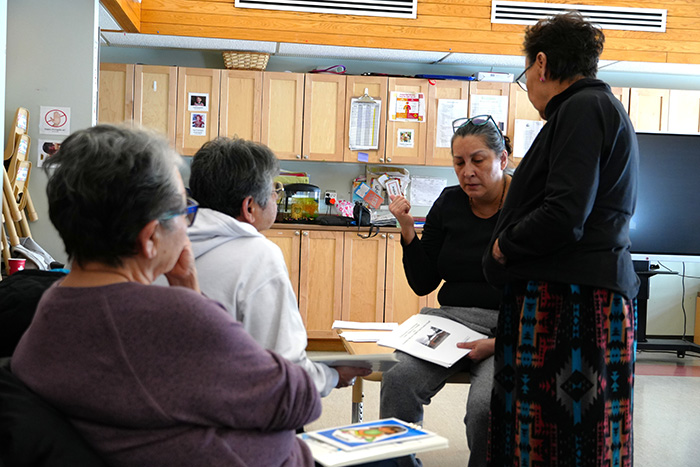
Before breaking for a lunch of Indian tacos, Marjorie concluded the morning session with methods for assessing Anishinaabemowin within the Daycare curriculum. Ensuring a ‘flow of continuance’ when learning Anishinaabemowin begins with developing curriculum at the Daycare level and developing evaluation methods for second language oral language assessment. Beginning these steps in Daycare will translate into continued, supportive learning once students enter Biidaaban. She explained that Biidaaban Language Speakers will need to know and witness what is being taught/learned in Daycare, so that appropriately advanced curriculum can be developed as students progress from the initial learning base. We want to support our educators on this journey towards language revitalization -- within their roles as individuals and in their family/community environments. Parents also need to be aware of what we will be teaching about Anishinaabe-Aadziwin so they can be part of educating our youngest members and help provide continuity at home. Marjorie described an all-season language plan for the Daycare, incorporating pertinent cultural seasons such as winter feast, spring solstice, round dance, planting, medicines, powwows in summer, fall harvesting, feasts and ceremonies, weekly smudging, and more, as well as incorporating the medicine wheel and four directions within this instruction model. The use of land-based teachings will support this plan, as will Anishinaabemowin Speakers available in classrooms to provide a point of reference and encouragement to staff, learners, and families/community members as their language acquisition evolves.
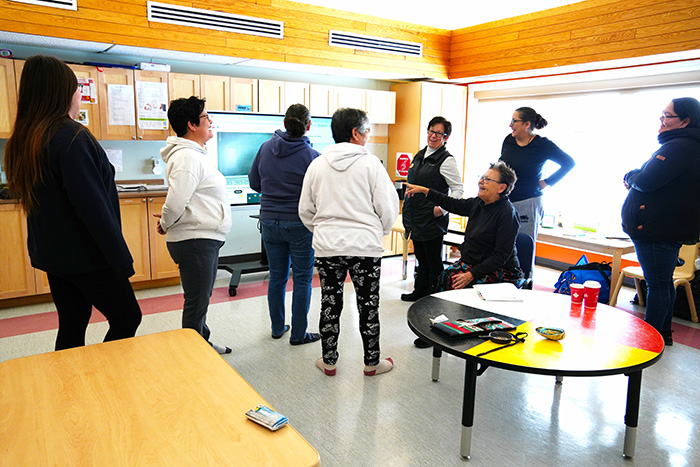
In summary of the morning’s presentation, Barbara reiterated the priority of “recognizing the importance of language revitalization in early learning spaces for both children and families.” She added the analogy, “When you plant seeds, something grows! So, at the Daycare, we are going to plant seeds -- language seeds.” As encouragement to everyone present, no matter their level of Anishinaabemowin, she suggested always incorporating the language. Set a small goal for yourself: use 2 or 3 words per day and evaluate your learning at the end of the day. Starting small and using the language daily will prove to be successful over the long term in revitalizing our beautiful language.