


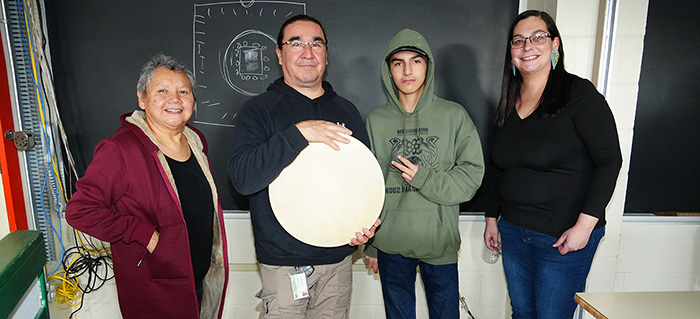
On Tuesday, December 2, 2025, during a one-hour Lunch ‘n Learn session at Espanola High School (EHS) Auditorium, Darren McGregor, Ekinoomagejig (Knowledge Keeper) with Nogdawindamin, provided students with an opportunity to gain knowledge about the Memorial Round Dance. The session was very well attended, with both Indigenous and non-Indigenous students present to learn. Miigwech to Guidance & Career Coach, Josephine Toulouse, and Karen Boyer, Indigenous Support Worker at EHS, for organizing this learning opportunity and the ‘traditional’ Subway lunch. All students of EHS are welcome to attend any Lunch ‘n Learn sessions offered throughout the school year. Contact Josephine Toulouse at: Toulouse_josephine@sagamok.ca if you or your student would like more information.
Darren began by giving a background history about the traditional purpose of the Memorial Round Dance and where it originated from -- Sweetgrass, Saskatchewan. He added that because it originated in the West, people didn’t initially hear about the tradition here in Sagamok; or the Eastern provinces in Canada. There was no means of extensive communication like we have available to us today. Through word of mouth and the continual sharing of information reaching further beyond single territories, knowledge about the Memorial Round Dance became more available, familiar, and eventually embraced by First Nations communities in Canada’s Eastern provinces, and worldwide. Darren clarified that there are Round Dance’s performed for weddings or birthdays, different from today’s discussion, but traditionally most were performed specifically for and called Memorial Round Dance.
A traditional Indigenous ceremony honouring and remembering family, friends, and community members who have passed into the Spirit World, the Memorial Round Dance is a gathering meant to be an inclusive and healing celebration of life. It offers connection, respect, and unity in a cultural setting. During the dance, participants join hands to form a circle and move in a side-step rhythm to the beat of the drum. Traditional practices included in the ceremony such as feasting, songs, stories, and sharing experiences or knowledge, help to provide comfort, healing, and hope to everyone in attendance.
Darren shared a story with the group which went like this: When we go through the Western door, we experience grief, and that is how the Round Dance started. There was a girl who lived with her grandmother, but when her grandmother passed on to spirit world, it was too much for the girl to bear. She went out into the woods to gather medicine and saw an entity that resembled her grandmother. Her grandmother called her in, beckoning her towards her to tell her it was okay to be sad but not okay to be sad all the time. Her grandmother told her the men of the community are going to join in a circle and sing/drum and when you enter the circle to dance with family and friends, it will help you overcome those feelings of grief and loss. This message came to her from the Spirit realm. So, this style of dance has a healing power that we ought to believe in. When we believe in these spiritual properties, it makes them that much more amplified, and healing and community is strengthened.
Darren then drew a picture on the whiteboard at the front of the room to demonstrate to students how a Round Dance is assembled. There are traditional practices that are followed for very special reasons; “everything has intention, purpose -- just like each of us,” Darren expressed. He emphasized how important it is that this generation continues to keep these traditions alive. He drew a square in the center of the board with people sitting all around it. He went on to draw people seated in a square all around the outermost section of the room. “Everyone dances in a circle around the center middle square,” he demonstrated. Darren was sharing this knowledge to help inform students how a Round Dance proceeds, to help prepare them for the upcoming Memorial Round Dance taking place in Sagamok just weeks away, on December 13. It was the first ever Memorial Round Dance to be held in Sagamok!
Darren continued describing various traditional components of the Memorial Round Dance, including that there is semaa (tobacco) present for people to make an offering or an intention with. It is wrapped in white cloth as a spiritual offering. The pipe is used during the ceremony; it is not used at every gathering. There is song, prayer, and dance. It is a time for people to dance with their loved ones who have journeyed on, by inviting them to be with them [in spirit] at the Round Dance. For the memorial aspect, he explained how attendees bring a photo of their loved one(s) who have journeyed on to the spirit world. This photo is placed face down on a memorial table. After one full completion of the Round Dance, the photo image is then turned face up within the circle for all to see, welcome, and celebrate with another full round of dancing. Darren also shared that one full year; four seasons; must have passed before you bring out those pictures and stories of the loved ones you are calling to the dance. One year is the time needed for our loved ones to journey from here; Turtle Island; to the spirit realm. This period of time also helps people to grieve and heal from their loss, so this is why it takes a full year before we attend a Memorial Round Dance in memory of our loved ones. Ribbon skirts and shirts can be worn to a Memorial Round Dance, but powwow regalia is not appropriate.
Darren spoke about the Stick Man and Singers, and those seated in the center square; the protectors of the doorway. The Stick Man holds several drumsticks, and he chooses who he will allocate to sing, throughout the ceremony. Singers get the chance to sing when they are presented with the stick(s), and however many sticks they are given is the number of songs they can offer. The Round Dance songs can encompass many languages (it is an inclusive celebration) including English, Cree, Ojibwe etc. because we are celebrating with all our ancestors. Darren shared, “When we dance around the center square, we open a doorway for our ancestors to come and visit us. When everyone joins hands, everyone’s energy is connected so we can help each other heal. And by holding hands together, we help protect our loved one’s spirits within the circle, so they don’t become disoriented.” At this point, he mentioned to students that the person journeying to the spirit world no longer has human emotions like greed, anger, or hatred because they are immaculate entities now, free from these human characteristics. He spoke about the belief that the Northern Lights are our ancestors dancing in the night sky. He went on to explain that the men who sit in the inner square are protecting the doorway where our loved ones’ spirits enter the Memorial Round Dance. These men keep the area safe for everyone participating.
Darren concluded the session by playing a song on his drum, demonstrating to students how he allows his fingernail to vibrate on the backside to create a unique sound. He reminded students about the upcoming Memorial Round Dance being hosted by Sagamok. Singers, Drummers, Pipe Man, Stick Man will travel to Sagamok from all over Ontario – and beyond! - because they have special abilities for Memorial Round Dances. It has been noted at Round Dances in Saskatchewan, that youth would begin arriving between 9-11pm, so they shared with other tribes how the youth were supported through this opportunity to gather and heal together in otherwise remote areas. Round Dances can be performed year-round, not only in winter. It is a great time to socialize, ‘get some steps in’, and become more familiar with your community members and traditions. More and more dances are being held regularly across the country as the word spreads, and the popularity of these community gatherings for healing opportunities grows. At the end of the Memorial Round Dance is the “Going Home” song and drums are placed face-down to let visiting spirits know that the dance is ending. He suggested the students attend the Memorial Round Dance in Sagamok for the purpose intended, but also to continue their knowledge and understanding. Students were reminded by Josephine and Karen of the Winter Solstice gathering taking place the following week at EHS, and to join the Feast and Social Time. Festivities, including a Round Dance, would welcome the entire student body and staff to participate, in preparation for the Christmas break and winter solstice season.
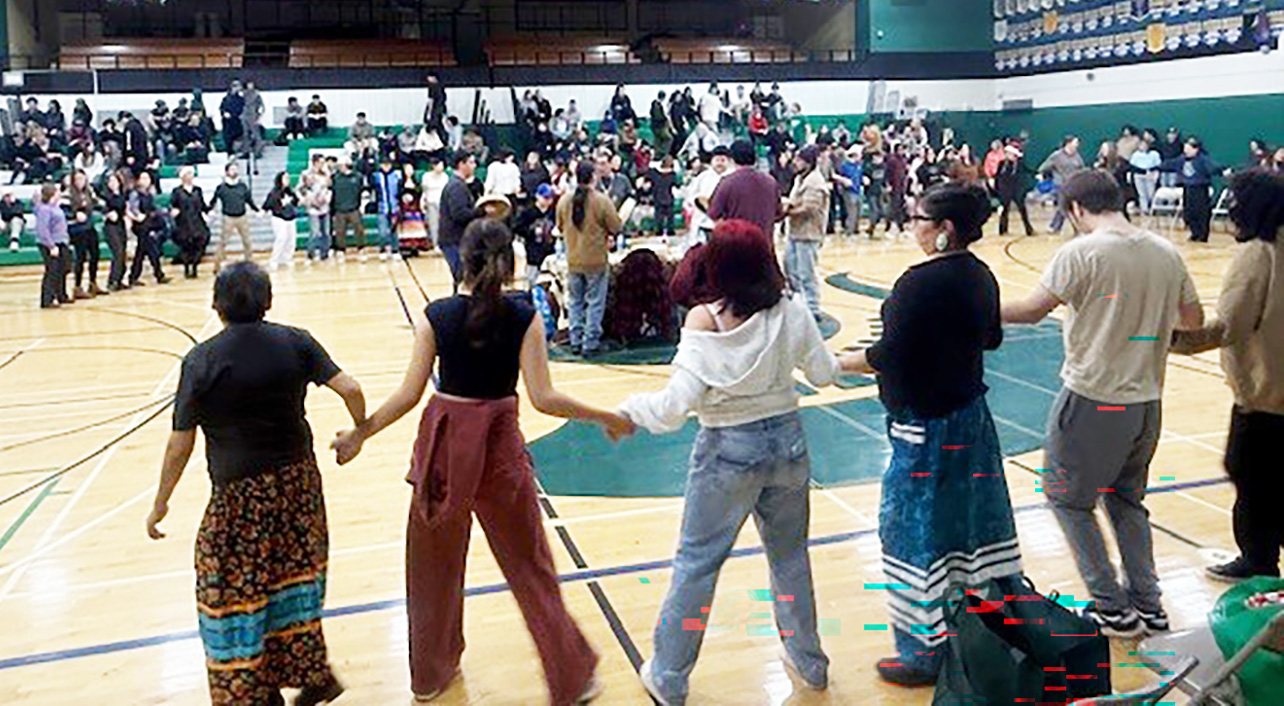
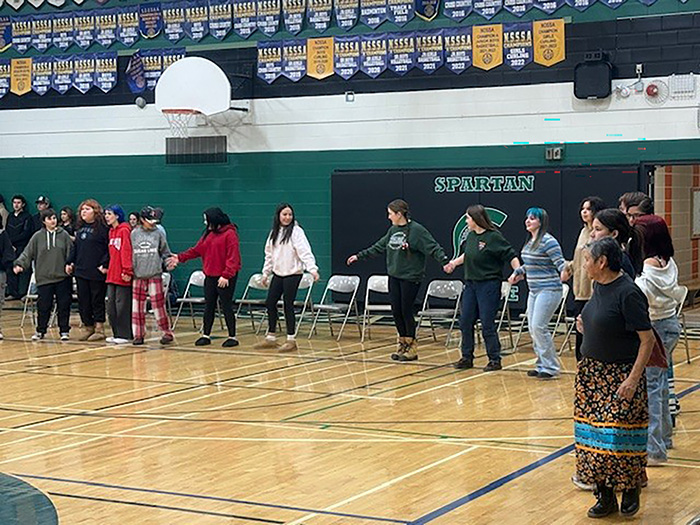
Miigwech, Darren, for providing such thorough and intensive learning about the Memorial Round Dance, and sharing your knowledge with future cultural leaders. Miigwech, Karen and Josephine, for offering support and guidance towards cultural continuity and growth.