


Quill Dying – Land-based Learning – Nov 21/25
Ms. Poirier’s Grade 6/7 class learned about dying porcupine quills from Land-Based Lead, Michael Abitong. “Our ancestors talked about how to dye porcupine quills so we’re going to learn about that today,” Michael started off. He asked the students to begin reflecting on things like:
- Where do we get the items to dye the quills with? And how do we start?,
- What do we use the entire porcupine for when we harvest one? and
- When we start to think about and learn about the land we think what’s growing out there? What’s happening?
- When do we harvest a porcupine?
Michael went on to provide some of the answers. He talked about the natural items that ancestors from long ago would gather from the land to dye the quills. “There were no commercial items to purchase back then,” said Michael, “and moving forward, the liquid dyes (oxidizing agents used today) were not so easy to get; you had to trade or spend zhoon’yaa (money) to get them, and they were very expensive.” He explained, “Our people used things found in nature to dye the quills because we used what we had, what was available to us.” Michael shared that the colours of the medicine wheel stem from “Indian Corn”, considered a food staple helping ancestors to survive in a harsh/tough environment. Michael demonstrated that you could see all four colours throughout the kernels on the cobs; mskwaa (red/burgundy), ozaawaa (yellow), waabshkaa (white), and mkadewaa (black/dark purple). He encouraged the students to utilize tools available to them today to continue researching what their ancestors used to do. They can search up on their computers questions like, “How do I dye porcupine quills?” The information varies based on region and communities by what was available and what their practices were/are.
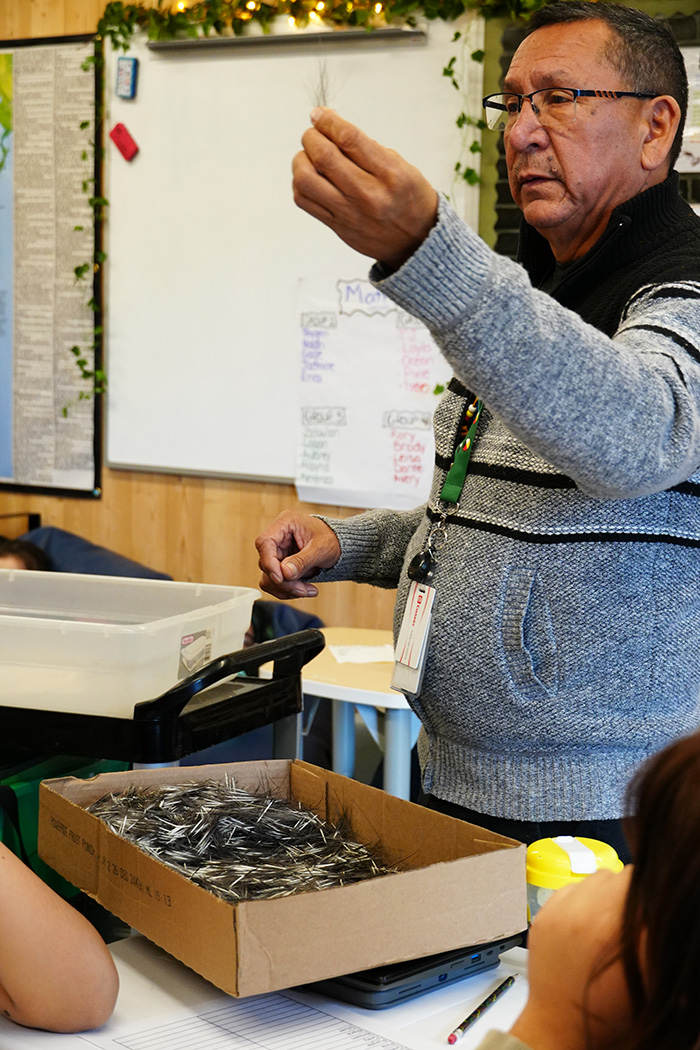
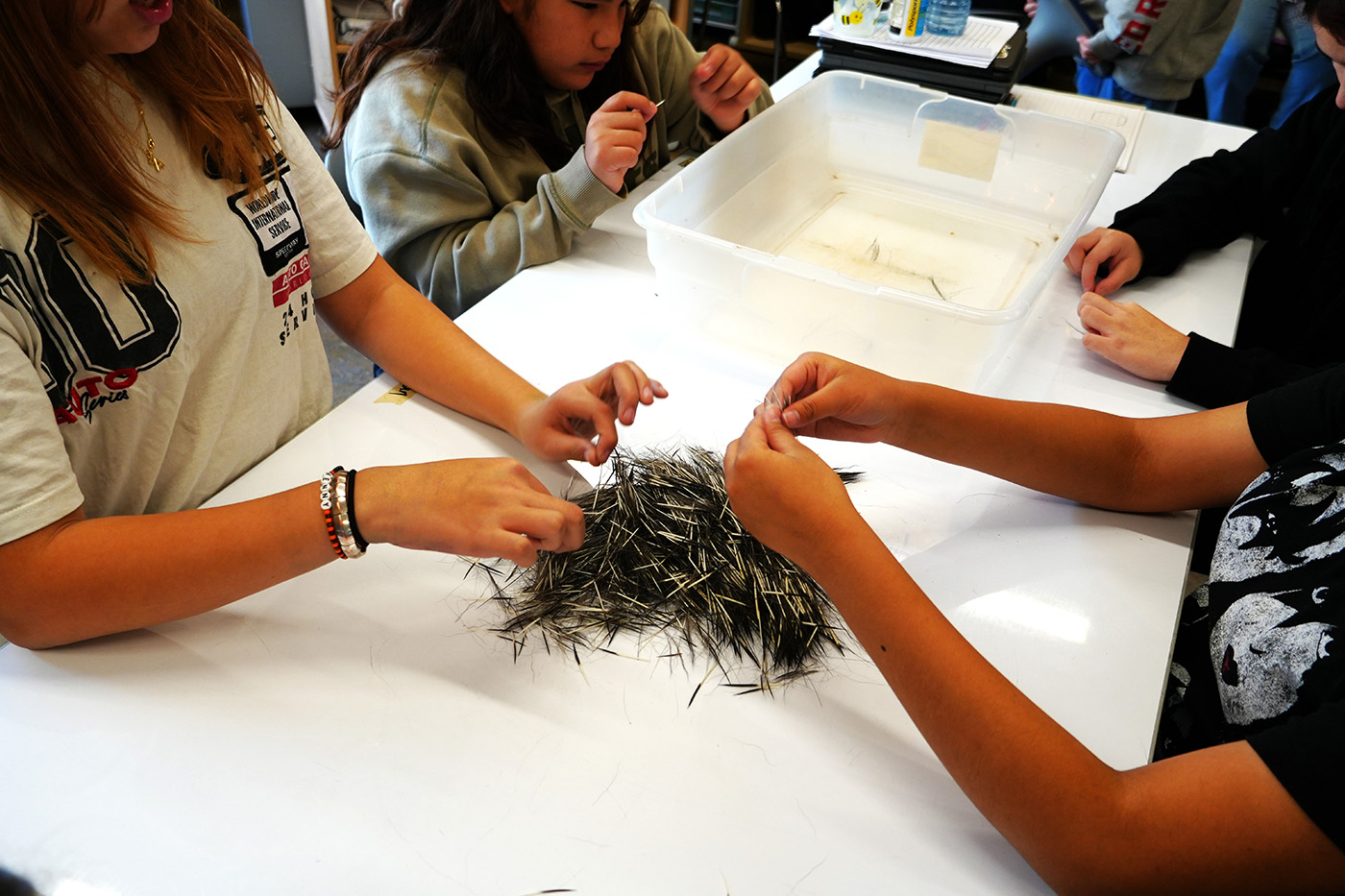
The entire gok (porcupine) is put to use; each part serves a purpose. At first, we gather our resources needed and then we need to separate them, shared Michael. The hair on the quills needs to be cleaned away and put in a separate container. Michael presented large bins of harvested porcupine quills to the students’ tables, along with a container to put the cleaned quills into and the hair that was removed from the quill into another. The hair is used for regalia, bustles, and dolls – reinforcing with students that ‘as Anishinaabe we utilize what we have and what we take from the animal’ and we offer tobacco as a thank you; to honour the animal for the sacrifice it made for us to be able to use it. The quills are used to make regalia, jewellery, storage boxes, gifts, and more. Porcupine meat is a good source of food and easy to capture due to their slow-moving characteristic. The bones are used for making tools, jewellery pieces (long beads), regalia for powwows, and more.
Once cleaned and separated, the quills are put into containers holding different colours of pre-mixed dyes (this is what was available to use today to demonstrate to students how the quill absorbs the coloured dye). This activity of separating the hair from the quills was tedious work, but the students became absorbed in the simple activity, working together quietly, watching their resources grow as the containers began filling up, and the classroom became a tranquil space. As students cleaned the quills together, they explored the smell of the quills and hair. “Smells like fish,” one student commented spurring others at the table to also take a whiff. And as inquisitive learners, they tested the sharpness of the quills on their fingertips. Very sharp! Resembling a sewing needle; thin on one end with piercing sharpness, growing larger where the quill attaches to the porcupine, and opening into a hole/tube (where the dye would enter).
The gok is best harvested in late niibin (summer), end of July or August, when the temperature starts changing. When the temperature changes, the porcupine also changes. The colour of its hair and the colour of its quills alter to match the changing landscape. In the ziigwan (spring), the quills have oil inside/around them. The oil comes from the bark/roots/evergreen needles they have eaten all winter, and it offers a protective measure for the porcupine’s health. It is not an ideal time to harvest them since the quills are messier to clean.
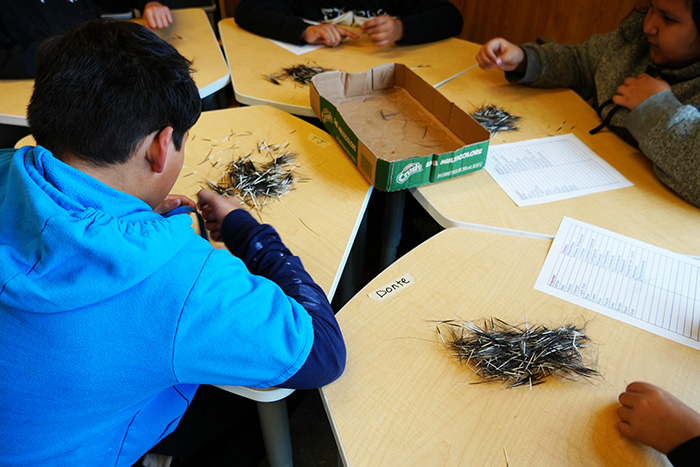
The learning offered during this study unit was rich in history, culture, and tradition. Students practiced social skills including interaction, teamwork/community, motor skill/coordination exercises, as well as creativity as students determined what colours they could dye the quills, the mixing/dying process, and how the quills might be assembled to create something uniquely from themselves. Miigwech to Michael for sharing his knowledge with the students about the gok and quill dying!
Students received this list of enaandek (colours) in Anishinaabemowin/English as part of their learning:
Waabshkaa – White
Mskwaa, Mskwaande – Red
Ozaawaa – Yellow
Ozaawaamiingaande – Orange
Giizhigaande – Light Blue
Miinaande – Blue
Ozhaawshkwaa – Green
Giniiwaande – Pink
Zhoominaande – Purple
Waabaande – Grey
Kiiwaande – Brown
Mkadewaa – Black
Zhoonyaawaande - Silver