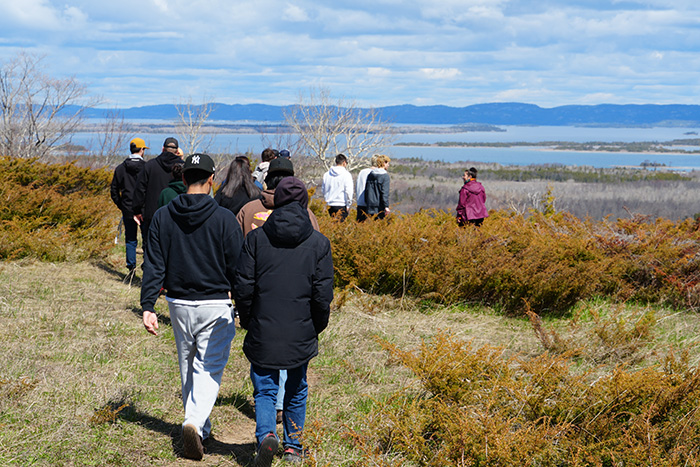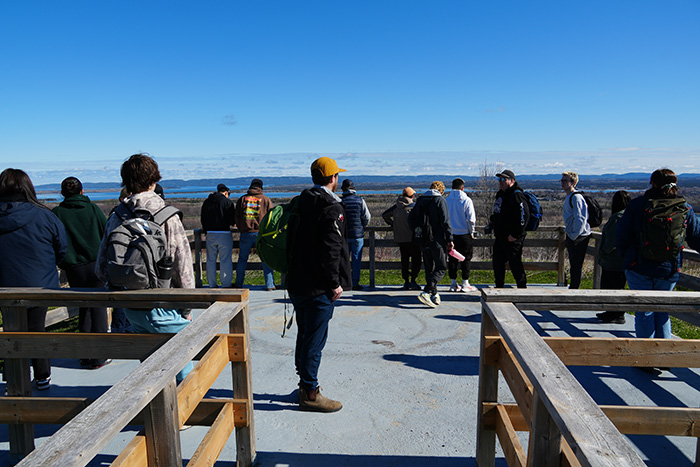
On a brilliant, azure-blue sky day, Mr. Beamish’s Ravens and Mr. Hannah’s Outdoor Education class, along with Teacher Apprentice, Ms. Clairmont, participated in a hike at McLean’s Mountain on Manitoulin Island. Situated between Little Current and Aundeck Omni Kaning (AOK), the site of this educational outing offered Espanola High School students an opportunity to go on a reflective journey. The journey began with glimpses of the shelves and rock cuts of the Precambrian shield, Whitefish River First Nation territory, and the famous swing bridge at Little Current while en route. Creator’s classroom unit today, organized by student Daniel Morningstar, invited Wiikwemkoong’s Sophie Pheasant to facilitate a medicine walk.
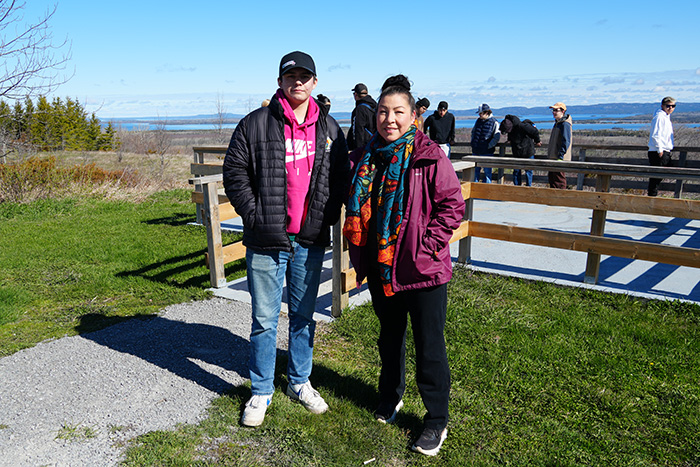
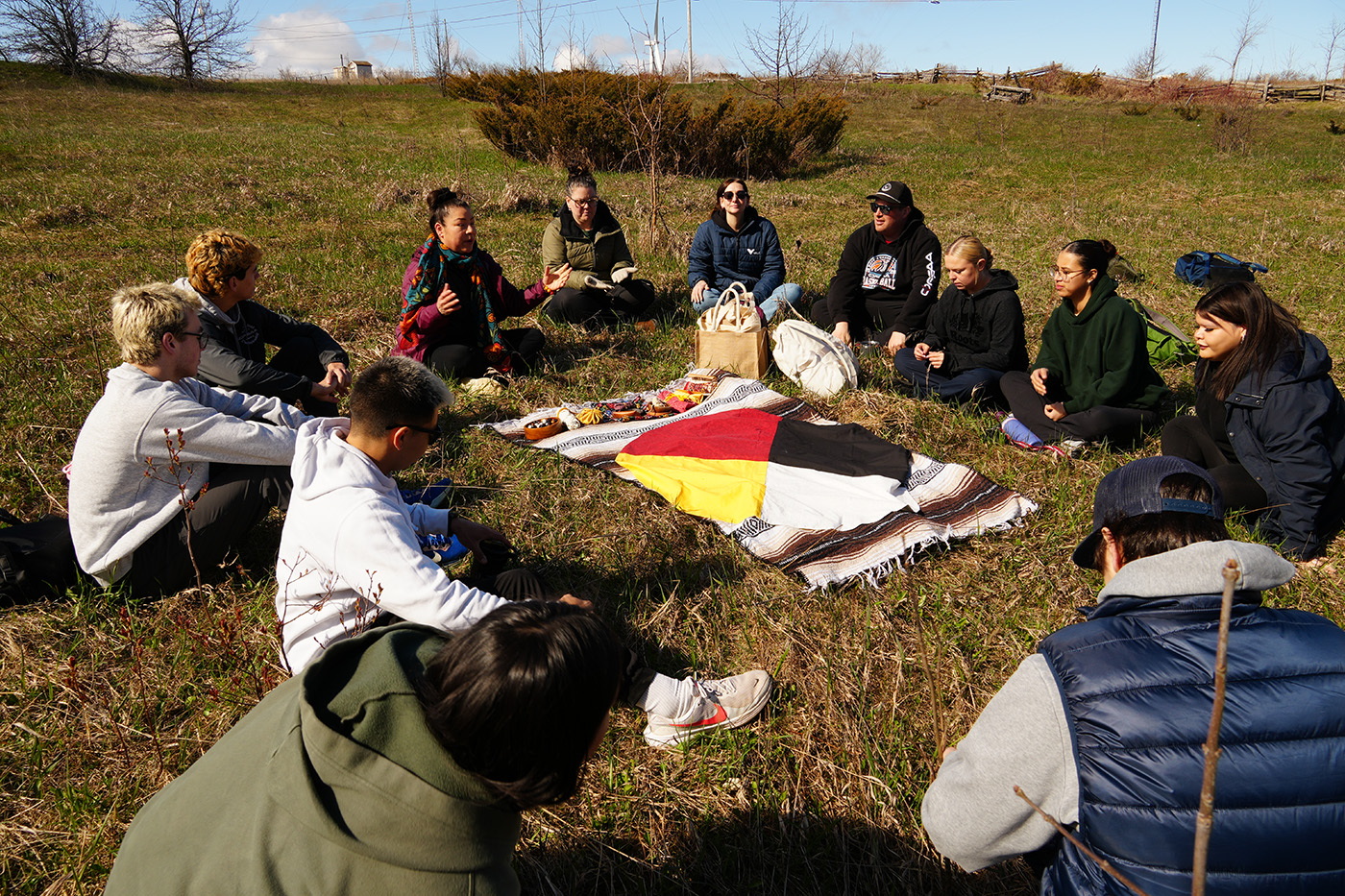
The experience began with Sophie engaging students in a discussion of the four directions of the medicine wheel, and where we were positioned accordingly. A large cloth medicine wheel was spread out on the ground, facing the correct direction in relation to the colours:
· White to the North (symbolic of the moon, winter, and elder stage of life);
· Yellow to the East (location of the sun rise, symbolic of new beginnings, childhood);
· Red to the South (symbolic of warmth, element offire, summer and youth); and
· Black to the West (symbolic of the setting sun, the element of water, autumn and adulthood).
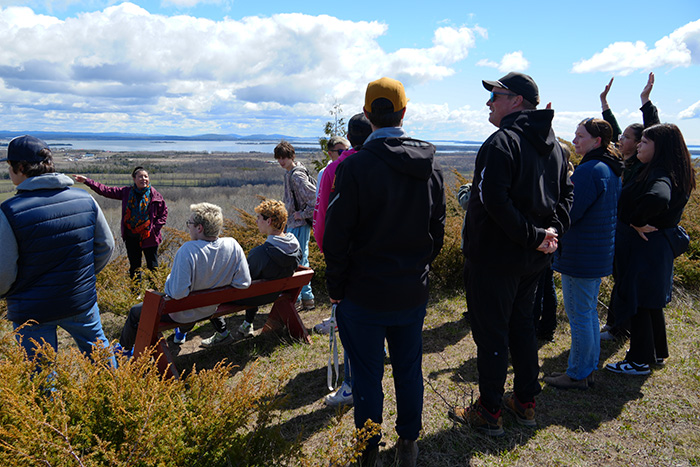
Through gentle stretching and focusing our attention, we brought ourselves and our minds into the space we were inhabiting and towards our purpose for being there. With arms stretched skyward, we pivoted first toward Mishomis (Grandfather) Sun and then to the ever-visible Nokoomis(Grandmother) Moon, offering gratitude and expressing our internal intentions for the medicine walk ahead. Sophie reminded everyone that even in the middle of the wild terrain, we can feel supported by Grandfather Sun and Grandmother Moon, always there to protect us with their comforting presence, and connect us to creation. The spring wind still held a chill as it rustled the golden grasses beneath our feet, and the aundeck (crows) squawked their presence, as they drifted sideways through the sky, haphazardly entering our sight, watching us with curious and deeply observant eyes.
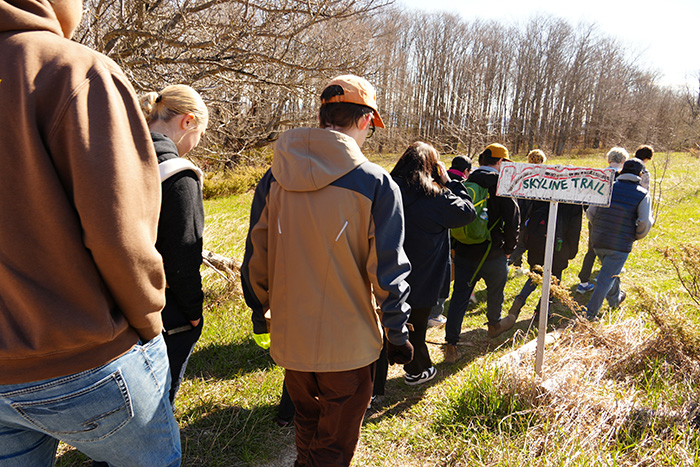
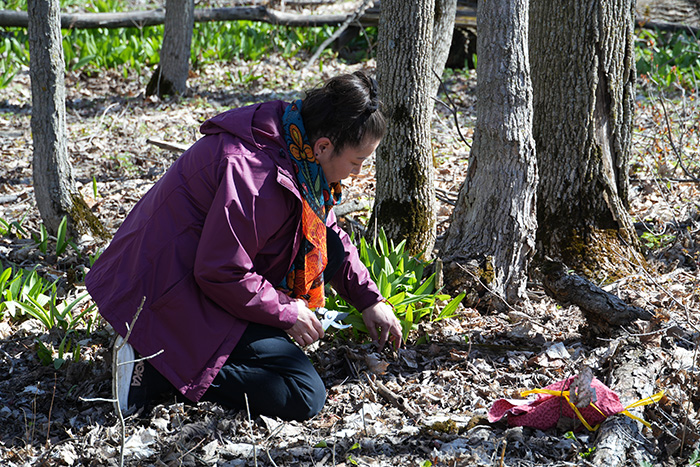
With Sophie leading the expedition, students hiked the Skyline trail, offering spectacular panoramic vistas of Little Current, the La Cloche Mountain Range, and the North Channel of Lake Huron. The hike led everyone along the high, forested ridge of the mountain, with Sophie pointing out various plants and tree species along the way. Her knowledge was shared to help students identify the plants and trees used in traditional medicines, the places where they grow, the proper seasons to for harvest, and to learn about their healing benefits, which are still used today. Some of the plants included:
· Wild leeks (a source of nourishment tasting much like an onion) which grow near Maple trees and sprout from the earth inspringtime;
· Trout lily (a speckled pattern on oval, fish-shaped leaves that mimic a trout and have a small yellow star-flower in spring);
· Poplar buds with their notable aroma when crushed open;
· Red willow (used for pain relief and the main ingredient used in the pharmaceutical Aspirin);
· Aspen bark (used as sunscreen);
· Juniper berries/bushes (used for flavouring meats; tea remedy); and
· A few remaining cedars (medicine for healing, tea, cleansing) framed the view at the conclusion of the hike and the precipice of the trail.
Returning to the medicine wheel, participants were invited to choose from a selection of wooden beads to thread onto a leather strip. The beads were meant to symbolize the walk we had completed together, and each person was invited to share a couple of memorable moments or pieces of knowledge gained from the day. The circle of reflection allowed everyone to connect in a special way, understand each other a little bit more, and perhaps recognize something that had gone unnoticed but was brought to their attention through the joy it sparked in the speaker. Most expressed a great sense of freedom and connection to the universe experienced through the simple act of the gratitude prayer to the sun and moon at the very start of the hike. Daniel offered some words of gratitude and meaningful reflection to close the medicine walk in a good way. Everyone was invited to take a pinch of semaa (tobacco) using their left (heart) hand, to present to their favourite part of the hike and offer an intention there.
The following summary was submitted by Daniel Morningstar, giving his student perspective on his involvement with organizing and facilitating the outing:
“When Mr. Beamish first brought up the trip assignment, I was nervous. However, after a few days of brainstorming, Mr. Beamish and I came to a selection impasse and chose to reach out to Sophie Pheasant for a Medicine Walk. After a few weeks of planning and communicating among the three of us, we chose a date and time. Mr. Beamish added, “We’ll be there rain or shine.” His motivating words uplifted my spirit, and I was no longer nervous. After we selected a date and time, we had to plan transportation, so we asked Mr. Hannah’s outdoor education class to join us on the trip so that we could reserve a bus. Mr. Hannah agreed almost immediately! Mr. Hannah asked me to go to his class and explain what we will be doing on the trip to encourage attendance. I found myself nervous again, however, I still went to his class and found that his class wasn’t full of strangers but people I’ve interacted with throughout my time at EHS. I explained to them what we were doing and they sounded excited when I left. Mr. Beamish and I finished forms and handed them out and went to pick up water bottles for the students. The day of the trip arrived, and we loaded up the bus and headed out to McLeans Mountain Lookout, where we met with Sophie and started introductions. Sophie took the lead and we went across the road atop the hill where she had set out her bundle and everything she would need for the day. We started with stretching and a prayer. Sophie then led us into the beginning of the bush and showed us Wild Leek; an onion. We picked some, and a few of the students tried taking a bite. It was fun and brought laughter. We then hiked up the trail and proceeded to acknowledge plants and medicines that were used for healing and miijim (food). The trail became a circle that led to a steep hill that we climbed and joked about together at the top. We came to a lookout where we observed the lakes and the Reservations in sight. We then moved on, back to where we started, taking turns sharing one thing we were grateful for learning today. Everyone made their round and it was a nice icebreaker, even if a few of us were still nervous. I brought a bag of Semma (tobacco) and shared a few words about it: “We grab medicine with our left hand because it is closest to our hearts, it connects them. It is important to remember that it is not how much you have or take but what you put into the medicine that matters. The same as our children or the plants we grow, we have to put our good thoughts into them for them to sprout.” After my words, we ended and returned to the bus. I handed out the exit tickets (evaluation) that Mr. Beamish and I had made, along with pencils. We went to 3 Cows for lunch, and everybody got some food or ice-cream. It felt like a short bus ride back to the school, mostly because I slept through it. We got off the bus and acknowledged that it was fun and educational.”
Mr. Beamish provided the following summary regarding the educational value of the outing:
“The Medicine Walk connected directly to the Ravens Program curriculum by blending outdoor education, physical health education, and Indigenous cultural learning. Many students are working toward Physical Health Education and Outdoor Education credits, and this land-based learning experience provided an opportunity for students to participate in outdoor activity while developing plant identification skills and learning about medicinal uses of local plants.
The activity also supported the cultural focus of the Ravens Program through teachings connected to the Medicine Wheel. Students are currently completing their Medicine Shields, where they earn beads through participation in field trips and experiential learning opportunities. For this Medicine Walk, students earned a black bead in the Mental quadrant of the Medicine Wheel, recognizing their participation in a learning experience focused on plant knowledge, observation, and understanding medicinal properties.”
Miigwech to Daniel Morningstar, Sophie Pheasant, Mr. Beamish, Mr. Hannah, Ms. Clairmont, and the students, for inviting everyone to take part in this culturally meaningful, physically invigorating, and informative excursion.